
Step 1: Basic forms
After arriving for your appointment, you will be prompted by the front desk to fill our a New-Patient Intake Form. This form will ask you for your general information and any pre-existing medical conditions. Once done, sit back and relax, the chiropractor will invite you in shortly.

Step 2: Discussing your condition
For the next 10-15 minutes, we will discuss your health history with you. Your chiropractor will also prompt questions to understand your condition better. Please feel free to ask any questions you have throughout the process!
Feel rest assured that we will keep you informed of every step of your treatment, making the entire process transparent for you.

Step 3: Physical examination
Once your chiropractor has established that your case requires chiropractic treatment, they will perform a physical examination to diagnose the issue. This usually takes about 15-20 minutes. For precise diagnoses, you may be asked to wear a clinic gown so that these tests can be performed effectively.

During the physical examination, your chiropractor will be looking for subtle changes in your posture, balance, movement patterns, and musculoskeletal system. This is will be performed using the Gonstead Chiropractic System.
In addition, your chiropractor will conduct palpation— Feeling for swelling, tenderness, and tightness in the muscles and surrounding tissues of your back, and investigating spinal segments to locate any loss of range-of-motion. Please express any concerns to your chiropractor, who will happily cooperate to ensure your comfort.
Often, further investigation using spinal X-rays is necessary for a proper diagnosis. You will be referred to obtain these before any adjustments are made.
Step 4: Prognosis and advice
With the X-rays, we will provide further explanation of the problem and a detailed prognosis for your treatment. If it is determined that you require alternative care, you will be appropriately referred to another practitioner. Sometimes, complex problems require both chiropractic and other healthcare treatments. We want the best outcomes for our patients, so knowing when and where to refer is just as important as providing chiropractic care when appropriate.
Step 5: Treatment
Once you’re fully informed, we will then treat you with the Gonstead Chiropractic Adjustment. This involves hands-on specific movement applied to only the problematic part found along your spine or any other joint in the body. The purpose of spinal adjustments delivered by chiropractors is to restore the misaligned vertebra to the correct position and restore normal disc mechanics. This reduces both the mechanical pressure if present due to a disc prolapse and reduces the nerve irritation from the associated inflammatory response.
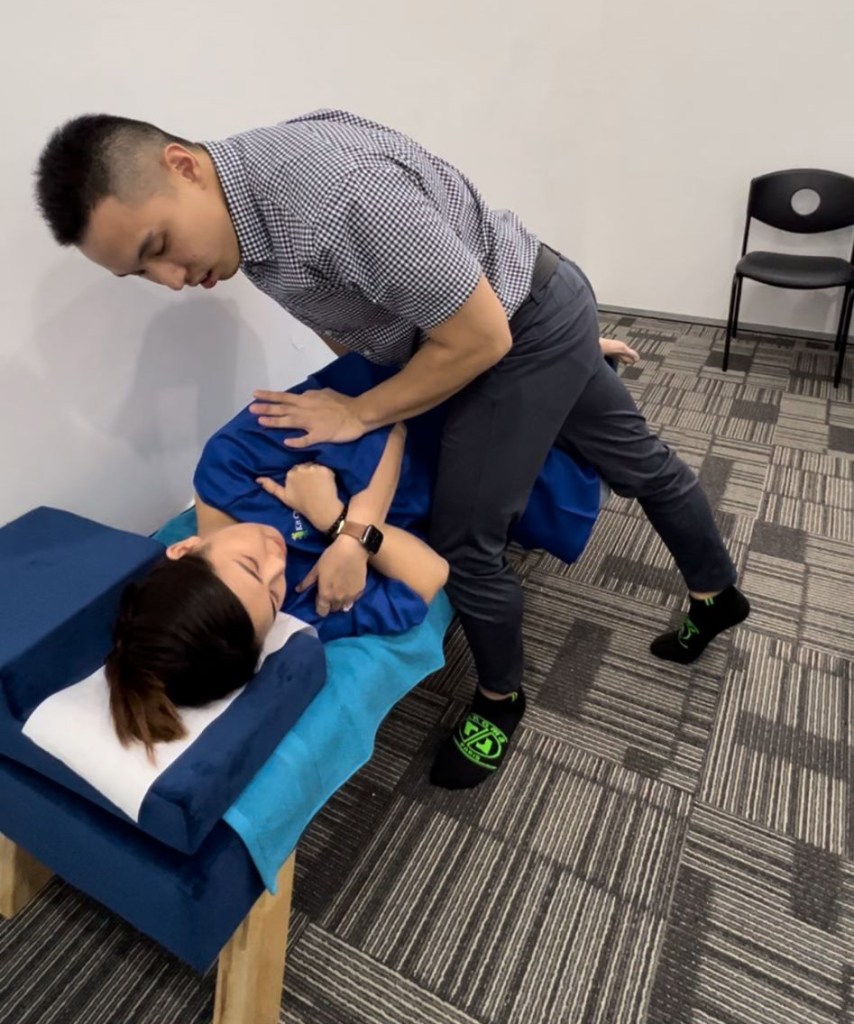
The noise you may hear from the adjustment will sound like a “pop”. Do not worry as it is not bone scraping on bone, but the release of air escaping from the capsule in the joint.
After your treatment, your chiropractor will inform you about aftercare procedures to ensure you make a speedy recovery.
Step 6: Your Care Plan
Each patient is different and unique, which is why we tailor our analysis and adjustments to you.
On your follow-up visit, we will re-examine your spine to assess what has changed and decide what adjustments are required on the day. These consultations can vary in length from 10-20 minutes and usually occurs days or weeks after the first adjustment depending on your condition. Your chiropractor will always let you know when you need your next spinal check.
Ideally, everyone should have their spine checked regularly to maintain function and mobility and thus reduce the risk of injury. We have been educated to have our teeth checked and cleaned every six months to catch problems early and maintain our oral health, rather than visiting the dentist when we are in pain. Pain is the body’s cry for help, and like a toothache, back pain is an indicator that your spine isn’t coping and damage has occurred.
By having regular spinal checks, you give yourself the best chance to maintain your spine and nervous system’s health. Besides reducing ongoing symptoms, you also prevent further damage to your spine.
 Kit Chiropractic